
Article 3 of 6
Most people think about returns first. But every loan you invest in has a real business on the other side, a company with employees, customers, and a reason it needs capital. Understanding who borrows and why is one of the most useful habits a new investor can build.
What You'll Learn
- Who may sit behind a loan listing.
- Why borrower and originator quality matter.
- Which borrower details investors should look for.
A loan listing represents a real repayment obligation
It is easy to look at a marketplace and see only numbers: interest rate, term, amount, and status. But every loan listing represents a real repayment obligation. Someone borrowed money for a purpose, and the investment result depends on whether that obligation is repaid.
Borrowers can differ widely
Borrowers may be consumers, businesses, real estate participants, or other profiles depending on the loan type and platform model. Some are short-term, while others have longer repayment schedules.
Different borrower types create different risk questions. A short-term consumer loan, a vehicle loan, and a business loan may all offer interest, but the repayment source, documentation, and recovery path can look very different.
On Afranga specifically, borrowers are vetted businesses that go through multi-stage due diligence before any loan is published. Every loan publishes the borrower’s name and key details in the KIIS, so you know exactly who you are lending to.
What investors can usually review
A good review starts with the basics: loan purpose, loan type, term, repayment schedule, interest rate, country, originator, borrower information that can be disclosed, and any available documents. Afranga notes that borrower personal data cannot be publicly revealed, but certain borrower-specific information is disclosed on the platform.
The goal is not to know everything. The goal is to know enough to decide whether the expected return compensates you for the risk and whether the investment fits your portfolio plan.
What “creditworthy” means in plain language
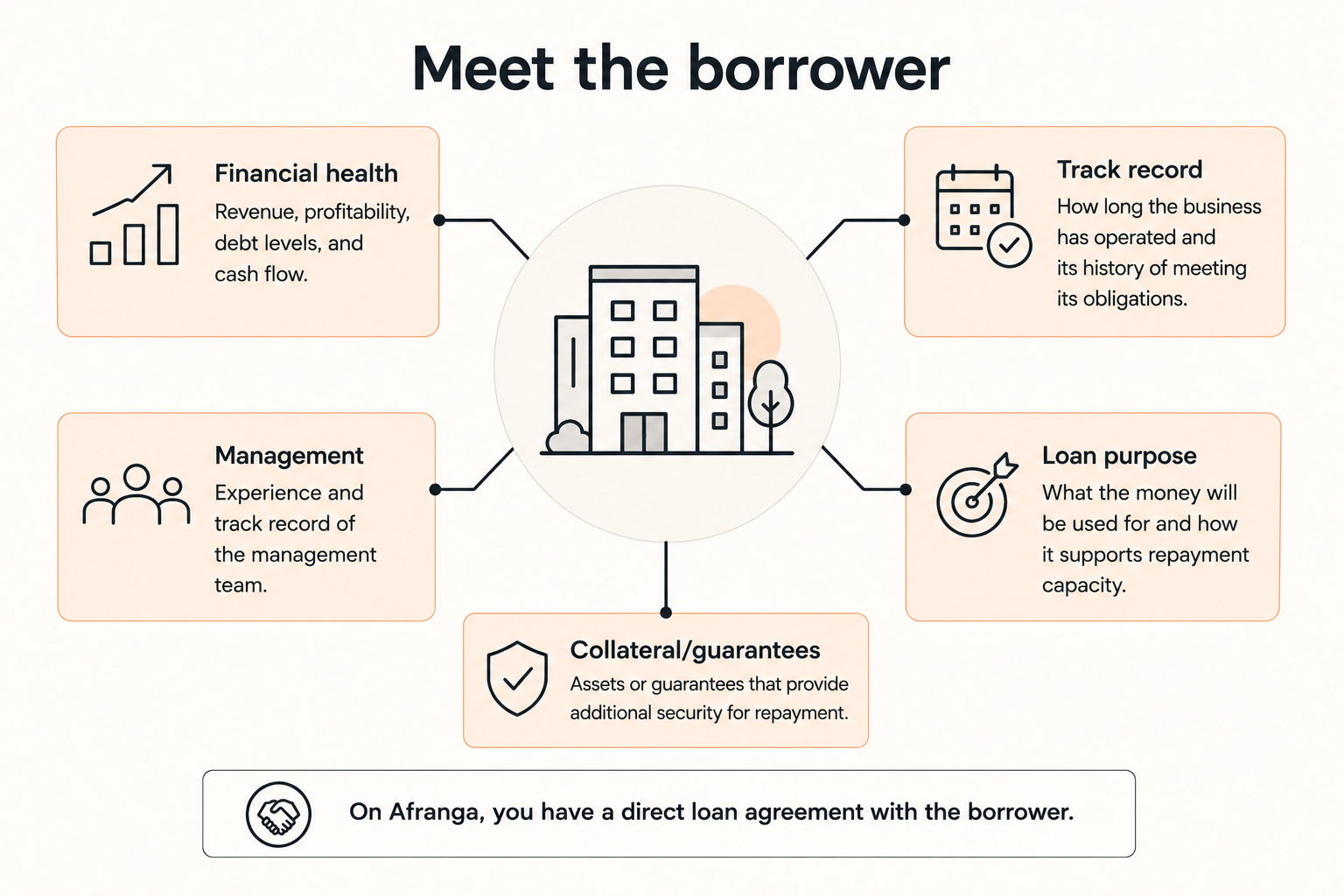
Due diligence is the platform’s process for checking whether a borrower can reasonably be expected to repay. At a beginner level, the main factors are:
- Financial health, revenue, profitability, existing debt levels, cash flow
- Track record, how long the business has operated, its history of paying its obligations
- Management quality, experience of the people running the business
- Purpose of the loan, what the money will be used for, and whether that use is likely to generate repayment capacity
- Collateral or guarantees, assets or third-party commitments that support repayment if the business runs into trouble
A vetted borrower is not a risk-free borrower. Vetting reduces the chance of a problem, but it cannot eliminate it.
The direct lending model on Afranga
In many crowdlending models, investors also need to understand the loan originator. The originator may source borrowers, assess applications, issue loans, collect repayments, and manage late payments.
Useful questions include: how long has the originator operated, what loan types does it offer, what information is available, what financial documents are published, and how concentrated is your exposure to one originator?
On Afranga, investors enter into a direct loan agreement with the borrowing company. You are the lender; the company is the borrower; there is no intermediary loan originator standing between you.
The practical consequence: the borrowing company is directly liable to repay the loan in full, and that liability is enforceable against all of its assets. This is different from platforms where a separate lending company sits between investor and borrower.
The honest part
Not every borrower repays on time or in full. Businesses face downturns, lose customers, or run into unexpected costs. That is why diversification, spreading your money across multiple loans, is part of every sensible crowdfunding approach, and why every loan publishes its risks in the KIIS.
Understanding the borrower is the start of being able to assess risk honestly. It does not remove risk. It makes you a better-informed investor.
Key Takeaways
- A loan listing is more than an interest rate.
- Borrower type, loan purpose, repayment source, and originator quality all matter.
- Investors may not see personal borrower data, but they should use the available loan and originator information.
- On Afranga, you have a direct loan agreement with the borrowing company. The company is liable with all of its assets.
- Borrowers can still default. Diversification is the main tool to manage this.
Quick Quiz
Question 1
Why is borrower context important?
A. It helps investors understand repayment risk
B. It removes all risk
C. It replaces diversification
Question 2
Can a high interest rate alone prove loan quality?
A. Yes
B. No
Question 3
Does due diligence eliminate the risk of default?
A. Yes, fully
B. No, it reduces but does not eliminate risk
C. Yes, if the borrower has been on the platform for over a year
D. Only for amounts below €100
