Article 1 of 6
Is your money working hard enough?
You’ve got €500 sitting in a savings account earning 0.2% a year. Meanwhile, a small business owner in Bulgaria needs €80,000 to buy new equipment — and their bank said no. Crowdlending connects these two people directly. You earn a real return. They get their loan. No bank in the middle.
What You'll Learn
- What crowdfunding is — and what it is not
- How crowdlending fits into the wider crowdfunding world.
- How crowdlending differs from bank deposits and stocks.
What is crowdfunding?
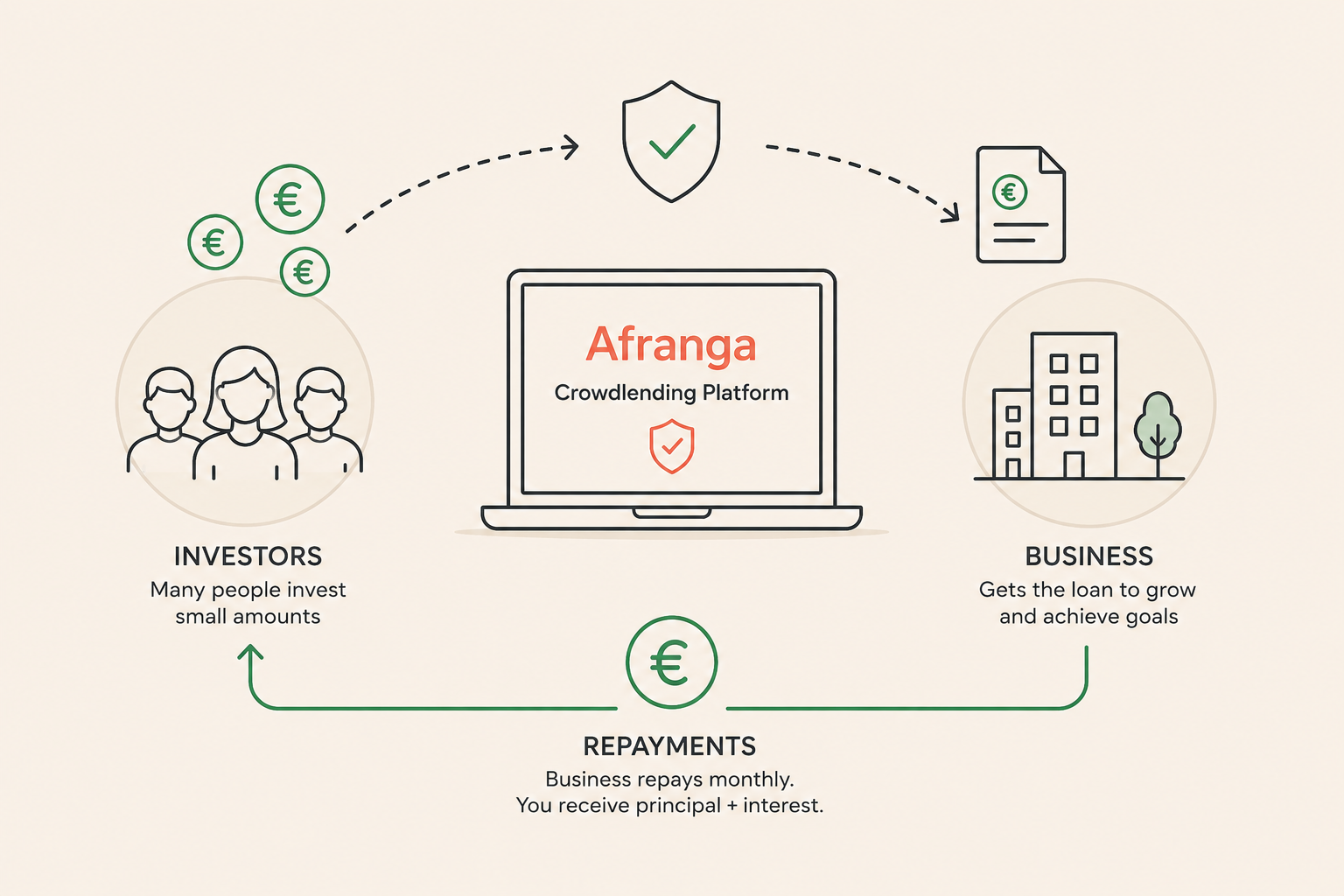
Crowdfunding is a simple idea: instead of one bank, institution, or large investor providing all the money, many people contribute smaller amounts toward the same funding need. That need can be a creative project, a business, a property development, a consumer loan package, or another approved opportunity. The word covers several different models, and it’s important to understand which type Afranga uses.
Afranga is exclusively a crowdlending/peer-to-peer platform.
You are always a lender, not a donor or a shareholder. You choose which loans to fund, you know your interest rate upfront, and you receive fixed monthly repayments.
How crowdlending compares to the alternatives
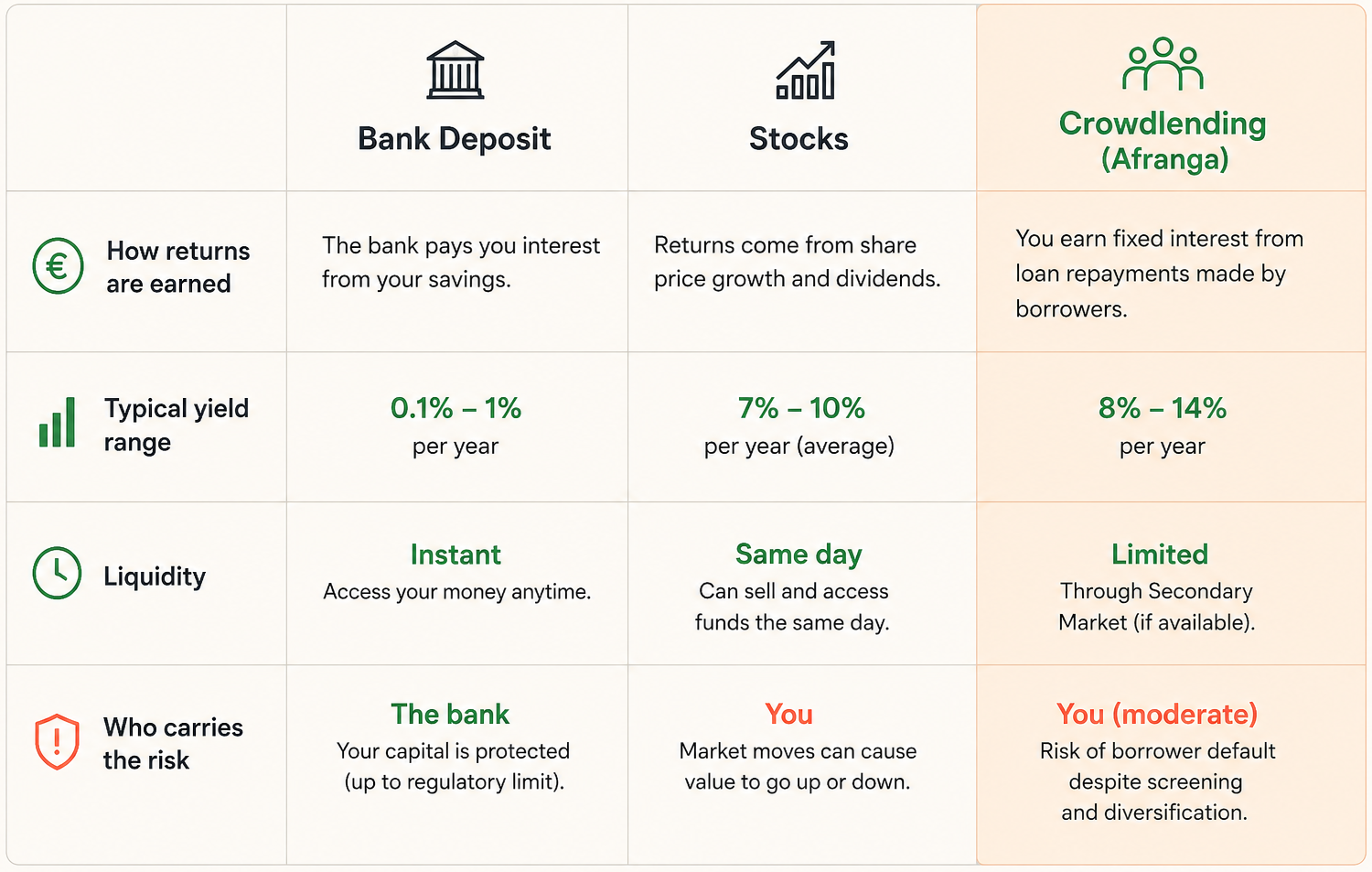
Most people are familiar with two ways to put their money to work: a savings account or the stock market. Here’s how crowdlending stacks up against both:
Savings accounts: safe but limited
In a savings account, the bank takes your money and decides what to do with it. You have no control over where your money goes or who it is lent to. Capital is protected (up to a regulatory limit), but returns are minimal - a tiny fraction of what the bank earns by lending your money out. The services and products offered by Afranga are not part of a European deposit protection scheme, and invested capital is at risk.
This distinction matters because higher interest in crowdlending is compensation for taking investment risk. Borrowers pay more to access faster, more flexible capital than a bank offers. That premium is what becomes your return.
Stock market: higher returns, higher volatility
When you buy a stock, you usually buy ownership in a company. Your result depends on the share price, dividends, and the company's long-term value. In crowdlending, you are not buying ownership. You are funding credit and expecting repayment according to loan terms.
Crowdlending: fixed returns, you choose
In crowdlending, you choose which loans to fund. The interest rate is fixed and defined before you invest. You receive monthly repayments of principal and interest throughout the loan term.
Where Afranga fits
Afranga is a marketplace for investing in loan-based crowdfunding offers. It connects investors with loan originating companies through a regulated platform environment. It screens and lists loans, handles all fund flows, collects repayments, and manages the relationship throughout the loan’s life. You never deal with the borrower directly.
Your role is simple: browse available loans, choose where to invest, and receive monthly repayments of principal plus interest into your Afranga account.
Key Takeaways
- Crowdfunding is an umbrella term. Afranga is specifically a crowdlending/peer-to-peer platform - you lend money to originating companies and earn interest, you are not donating or buying shares.
- Unlike a savings account, you choose which loans to fund, who your money goes to, and at what interest rate - the control is yours.
- Unlike stocks, returns in crowdlending are fixed and defined upfront. There is no market price fluctuating daily.
- Crowdlending carries real risk - borrowers can default. That’s why interest rates are higher than a savings account.
- The platform (Afranga) is the intermediary: it screens borrowers, structures loans, and handles repayments - but it’s your capital at work.
Quick Quiz
Question 1
What type of crowdfunding does Afranga offer?
A. Equity crowdfunding — you buy shares in startups
B. Donation-based crowdfunding
C. Debt crowdfunding — you lend money and earn interest
D. Reward-based crowdfunding
Question 2
How does crowdlending differ from a savings account?
A. Your money is 100% protected and guaranteed by the platform
B. You choose which loans to fund and earn a higher fixed interest rate
C. There is no difference — both are risk-free
D. You own a share of the borrowing company
Question 3
Why are interest rates in crowdlending higher than in a savings account?
A. Because platforms overcharge borrowers
B. To compensate investors for the real risk that borrowers may default
C. Because there is no regulation in this market
D. Because the government subsidises returns
Question 4
What is the main difference between crowdlending and investing in stocks?
A. Stocks are always safer
B. Crowdlending gives you ownership of the borrower’s business
C. Crowdlending returns are fixed upfront; stock returns fluctuate with market prices
D. There is no difference in risk profile
